Back to BlogCorporate Gift Selection 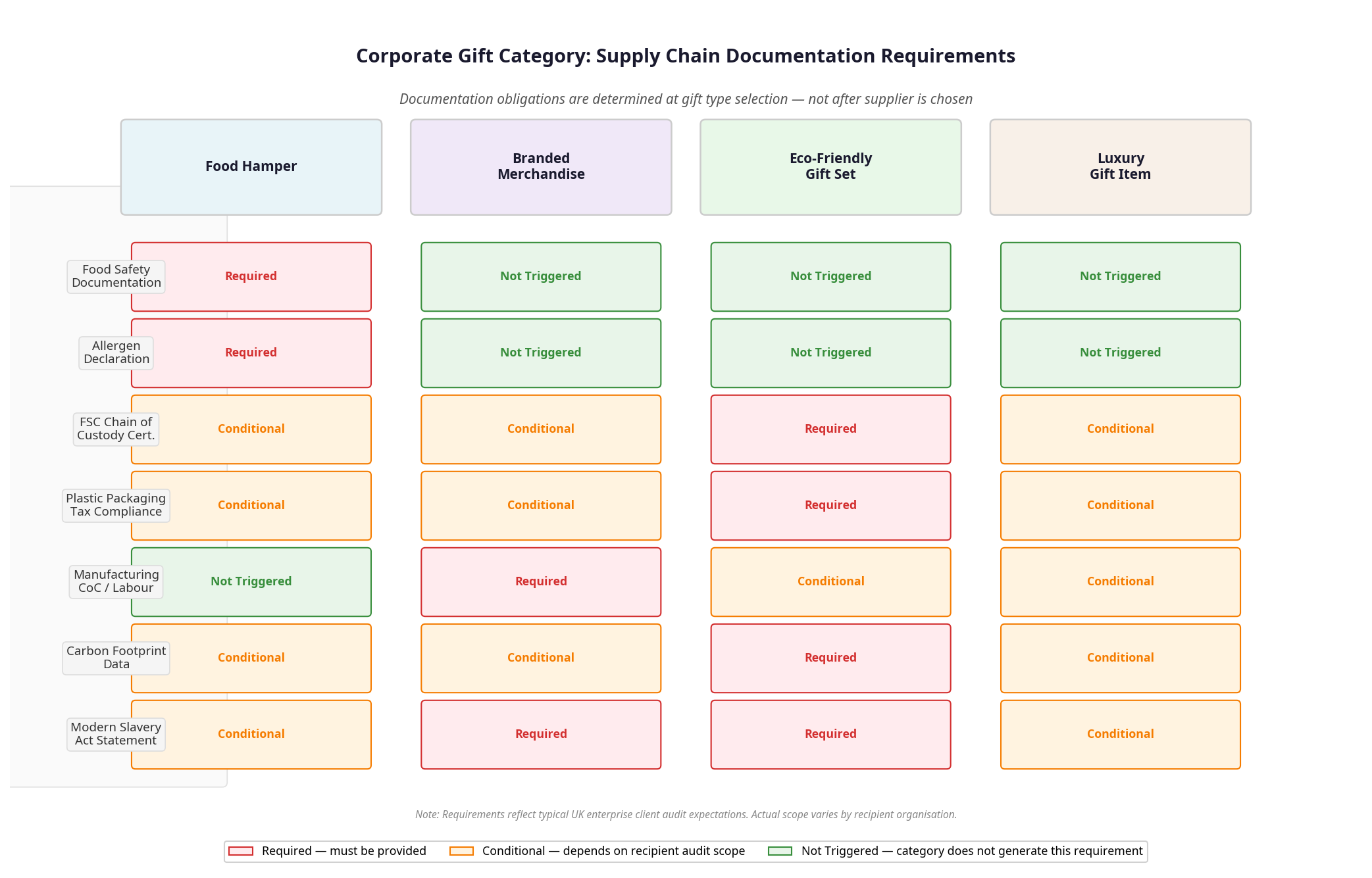


Why the Corporate Gift Box You Selected for Its ESG Image May Fail Your Client's Supplier Audit
6 March 2026
There is a particular kind of procurement error that only becomes visible several months after the gift has been sent. A company selects a curated eco-friendly corporate gift box for its key accounts—responsibly sourced contents, kraft paper packaging, a card describing the sustainable credentials of each item. The gift communicates exactly the right message about the sender's ESG values. It is dispatched, received, and appreciated. Then, in the following quarter, the recipient's procurement team conducts its annual supplier sustainability audit. The gift supplier—the company that assembled and dispatched the boxes—is asked to provide FSC Chain of Custody certification for the packaging, a Plastic Packaging Tax compliance declaration, and a Modern Slavery Act statement. The supplier cannot provide any of these documents. The gift that was selected for its ESG positioning has created a supplier compliance failure in the recipient's audit records.
This scenario is not unusual, and it is not caused by carelessness on the part of the procurement team that selected the gift. It is caused by a structural gap in how gift type decisions are made. The procurement team evaluated the gift on its visible credentials—the recycled materials, the ethical sourcing claims on the product cards, the absence of plastic wrapping. What they did not evaluate was whether the gift supplier's supply chain could produce the documentation that the recipient's procurement function would eventually require. These are two entirely different questions, and the first is almost always asked while the second is almost never asked.
[IMAGE:/images/blog/gift-selection-supply-chain-documentation-matrix.png|Matrix showing the documentation requirements triggered by each corporate gift category: food hampers require allergen declarations and food safety certificates; branded merchandise requires manufacturing chain of custody and labour standards documentation; eco-friendly gift sets require FSC certification and organic certification verification; luxury items require provenance and materials sourcing documentation]
The documentation requirements triggered by a gift depend almost entirely on the gift category, not on the gift's price point or the supplier's stated values. A food hamper—even one assembled from premium artisan products—triggers food safety documentation requirements, allergen declaration obligations, and country of origin labelling rules that apply to each component. A branded merchandise gift set triggers manufacturing chain of custody requirements, particularly if the recipient operates under a Modern Slavery Act compliance programme that extends to tier-two and tier-three suppliers. An eco-friendly gift box assembled from FSC-certified materials triggers Chain of Custody certification requirements that must be held by every entity in the supply chain, not just the forest of origin. A luxury gift item triggers provenance documentation requirements that can extend to the sourcing of raw materials.
The practical consequence is that the gift type decision is simultaneously a supply chain documentation decision—but it is rarely treated as one. When a procurement team decides to send eco-friendly corporate hampers to their top fifty accounts, they are implicitly committing to a supply chain that can produce FSC certification documentation, recycled content declarations, and potentially carbon footprint data per unit. When they decide to send branded merchandise, they are committing to a supply chain that can produce manufacturing compliance documentation. These commitments are made at the gift type selection stage. The supplier selection happens afterwards. And it is at the supplier selection stage—when the order is already conceptually placed and the timeline is already set—that the documentation requirements are first discovered.
In practice, this is often where gift type decisions start to be misjudged at the procurement level. The team selects a gift category that aligns with the company's ESG narrative, then searches for a supplier who can fulfil the order. The supplier is evaluated on product quality, price, and delivery capability. The documentation capability—whether the supplier holds the certifications that the recipient's audit function will eventually require—is not part of the evaluation criteria, because the procurement team does not yet know that those certifications will be required. By the time the documentation gap is discovered, the order is placed, the timeline is fixed, and the options are limited to accepting the gap or finding a new supplier under time pressure.
[IMAGE:/images/blog/gift-selection-decision-sequence-error.png|Diagram showing the correct versus typical decision sequence for corporate gift procurement: the correct sequence evaluates documentation requirements at gift type selection stage, while the typical sequence discovers documentation requirements only after supplier selection, creating a timeline and compliance problem]
The recipients who are most likely to trigger documentation requests are precisely the recipients that corporate gifting programmes are most designed to impress. Large enterprise clients, FTSE-listed companies, and organisations with active ESG procurement programmes are the accounts that receive the most carefully selected gifts—and they are also the accounts whose procurement teams are most likely to conduct supplier audits that extend to gift suppliers. A gift sent to a small private company may never generate a documentation request. The same gift sent to a large corporate client with a Scope 3 emissions reporting programme may generate a request for carbon footprint data that the gift supplier has never been asked to produce and cannot provide.
The UK Plastic Packaging Tax, which applies to plastic packaging components containing less than 30% recycled content, adds a specific compliance dimension that most gift procurement teams do not consider at the type selection stage. If a corporate gift box contains any plastic packaging—inner wrapping, protective inserts, sealed food packaging—the supplier is required to account for the recycled content of those components. If the supplier is manufacturing or importing plastic packaging that does not meet the 30% recycled content threshold, they are liable for the tax. Recipient organisations that conduct supplier audits increasingly request Plastic Packaging Tax compliance declarations as part of their standard supplier documentation pack. A gift supplier who cannot provide this declaration creates a gap in the recipient's supplier compliance records—not because the gift itself is non-compliant, but because the documentation was never requested or produced.
The question of which gift types best serve different business needs, as explored in [guidance on matching gift categories to commercial context](/resources/corporate-gift-selection-guide), is typically framed around relationship objectives, budget levels, and recipient preferences. The supply chain documentation dimension is rarely part of that framework, because it requires knowledge of the recipient's procurement compliance requirements that is not usually available at the gift selection stage. What procurement teams can do is apply a category-level heuristic: gift types that involve complex supply chains—multi-component hampers, branded merchandise from overseas manufacturers, eco-certified products with multiple certification claims—carry higher documentation risk than gift types with simpler supply chains. A curated selection of UK-produced food items in FSC-certified packaging from a supplier with established compliance documentation is a lower-risk choice than a multi-component wellness set assembled from products sourced across multiple countries, even if the latter appears more aligned with ESG values on the surface.
The error is not in selecting gift types that carry ESG credentials. The error is in treating ESG positioning as a proxy for supply chain documentation capability. A gift box that looks sustainable—recycled materials, ethical sourcing claims, minimal plastic—may or may not be supported by the certification documentation that a recipient's audit function will require. The visual credentials and the documentary credentials are not the same thing, and procurement teams that conflate them will consistently select gift types that create supplier compliance gaps in the accounts they are most trying to impress.
You May Also Like
Rigid Box vs. Corrugated Mailer: Which Material Suits Your Premium Corporate Gifts?
A deep dive into the structural integrity, cost implications, and unboxing experience of rigid boxes versus corrugated mailers for high-end corporate gifting.
Foil Stamping vs. UV Spot: Elevating Your Brand Logo on Custom Gift Boxes
A technical comparison of hot foil stamping and UV spot varnish, analyzing visual impact, durability, and production costs for branded corporate packaging.