Back to BlogCorporate Gift Selection 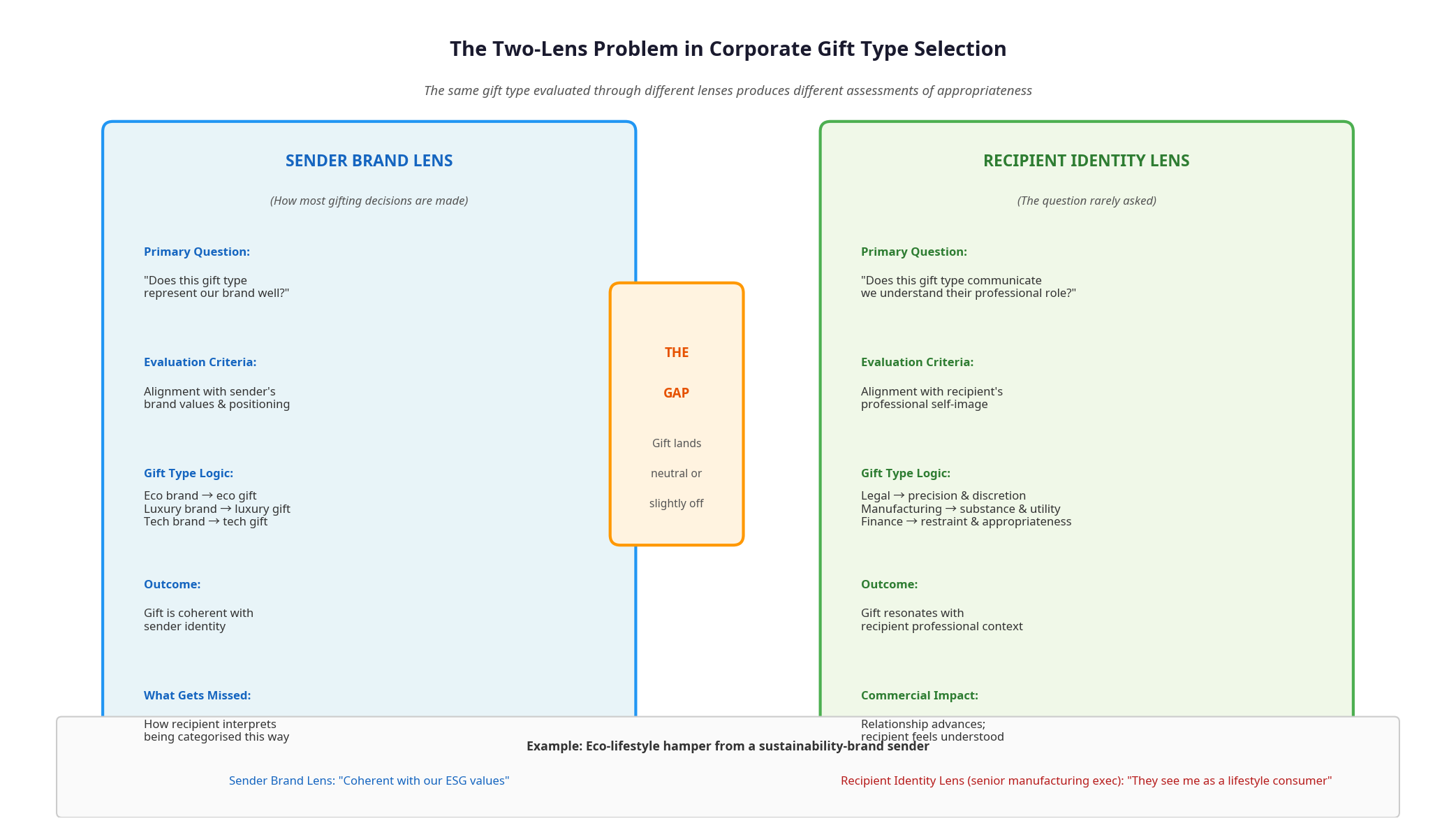
Why Selecting Corporate Gift Types Through Your Own Brand Lens Rather Than the Recipient's Professional Self-Image Creates Systematic Misalignment
2026-03-31
There is a dimension of corporate gift type selection that almost every gifting framework addresses indirectly but rarely names precisely: the difference between what a gift type communicates about the sender and what it communicates about how the sender perceives the recipient. These are not the same signal, and conflating them is one of the more consequential errors in B2B gift selection — consequential precisely because it produces outcomes that are difficult to diagnose. The gift is not rejected. It is acknowledged, thanked for, and forgotten. The commercial relationship is not damaged in any visible way. It simply fails to advance.
The standard approach to corporate gift type selection is organised around the sender's perspective. Teams ask: does this gift type align with our brand values? Does it reflect our positioning — premium, sustainable, innovative, professional? Does it represent us well? These are legitimate questions, but they are incomplete. A gift type does not only carry the sender's brand into the recipient's environment. It also carries an implicit message about how the sender has categorised the recipient. And that implicit message is evaluated, consciously or not, against the recipient's own professional self-image.
In practice, this is where gift type decisions start to be misjudged in ways that are difficult to trace back to the selection process itself. Consider a professional services firm that positions itself around sustainability and sends premium eco-lifestyle gift boxes — artisan candles, organic skincare, a reusable water bottle — to senior partners at a law firm. The gift type is coherent with the sender's brand. It is also, from the recipient's perspective, a gift that places them in the category of "someone who would appreciate lifestyle products." A senior partner at a law firm has a professional identity built around intellectual rigour, precision, and discretion. A lifestyle gift does not speak to that identity. It speaks past it. The gift is pleasant. It is not resonant.
The same dynamic operates differently across professional sectors, and this is where the structural nature of the error becomes clearer. Manufacturing and industrial procurement professionals tend to have a professional identity built around operational competence and practical problem-solving. Luxury consumable gifts — gourmet hampers, premium wine, artisan food sets — position the recipient as a consumer rather than a professional. The gift type communicates "we appreciate you as a person who enjoys nice things" rather than "we recognise you as a professional who makes consequential decisions." These are different messages, and the second is more commercially useful in a B2B context. A well-curated premium gift box containing high-quality branded functional items — a quality notebook, a precision pen set, a desk accessory with genuine utility — speaks to the recipient's professional context in a way that a gourmet hamper does not.
Financial services professionals present a different version of the same problem. Their professional identity is built around fiduciary responsibility and analytical rigour, and any gift type that carries a strong "entertainment" or "indulgence" signal creates discomfort that is partly compliance-related and partly identity-related. A premium hamper containing wine and cheese is not just a potential compliance disclosure issue — it is also a gift type that places the recipient in a social rather than professional register. The recipient may prefer to be recognised in a professional register, and a gift type that does so — a quality branded item that reflects their professional context — will land differently than one that does not.
Technology and creative sector professionals present yet another variant. Their professional identity often includes a strong sense of being forward-thinking and discerning. A generic corporate hamper — the kind that arrives in a standard branded box with a standard selection of items — communicates that the sender has not thought carefully about who they are gifting to. For a recipient whose professional identity includes being someone who notices and appreciates thoughtful curation, a generic gift type is actively counterproductive. It signals the opposite of what was intended.
The diagnostic question that most gifting frameworks do not ask is this: what does this gift type communicate about how we have categorised this person professionally? Not "does this gift type represent our brand well?" but "does this gift type communicate that we understand what kind of professional this person is, and that we are recognising them in that professional context?" These are different questions, and they produce different answers. A premium eco-friendly gift box may represent the sender's sustainability values perfectly while simultaneously communicating to a senior manufacturing executive that the sender sees them as a lifestyle consumer rather than an industry peer.
The correction is not complicated in principle, though it requires a different starting point for the selection process. Rather than beginning with "what gift types align with our brand?", the more productive starting question is "what does this recipient's professional context suggest about how they define professional recognition?" For a legal professional, recognition looks like discretion and quality. For a manufacturing professional, it looks like practicality and substance. For a financial services professional, it looks like restraint and appropriateness. For a technology professional, it looks like thoughtfulness and curation. These are not the same gift types, and they are not the same gift boxes.
The question of which gift types best serve different business needs cannot be answered without reference to the recipient's professional self-image. A premium branded gift box with carefully selected contents that reflect the recipient's professional context will generate a different commercial return than the same budget spent on a gift type that reflects only the sender's brand positioning. The gift type has not changed in quality. What has changed is whether it speaks to the recipient as a professional or past them as a consumer.
BritGift Works' bespoke corporate gift box service is structured precisely around this distinction — the ability to curate gift types and contents that reflect the recipient's professional context rather than simply projecting the sender's brand identity into an environment where it may or may not resonate.
You May Also Like
Rigid Box vs. Corrugated Mailer: Which Material Suits Your Premium Corporate Gifts?
A deep dive into the structural integrity, cost implications, and unboxing experience of rigid boxes versus corrugated mailers for high-end corporate gifting.
Foil Stamping vs. UV Spot: Elevating Your Brand Logo on Custom Gift Boxes
A technical comparison of hot foil stamping and UV spot varnish, analyzing visual impact, durability, and production costs for branded corporate packaging.