Back to BlogCORPORATE GIFT SELECTION 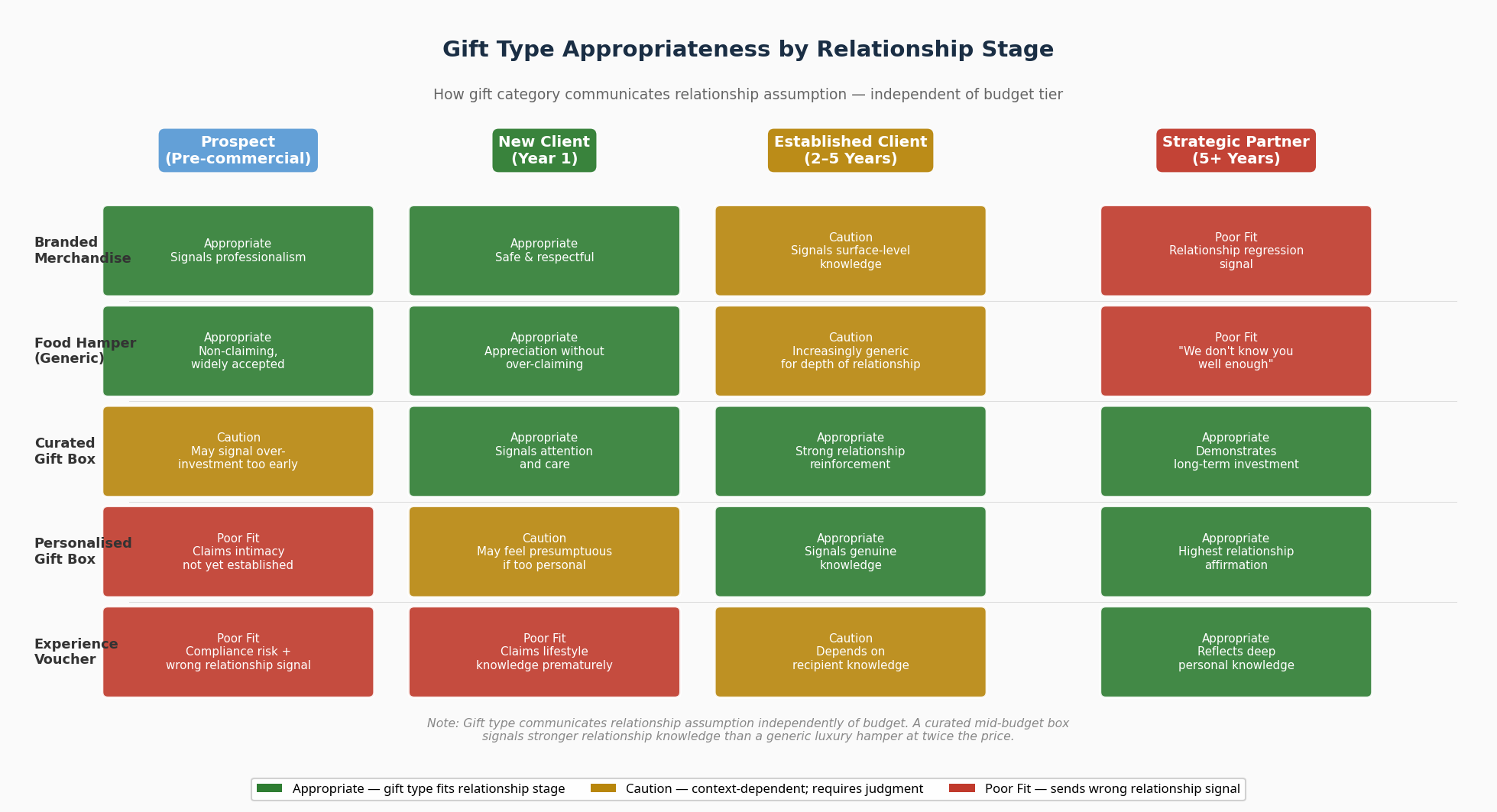
Why Your Corporate Gift Box Type Communicates Your Relationship Assumption—Not Your Appreciation
2 March 2026
The most persistent misjudgment in corporate gift selection isn't about budget, supplier quality, or delivery timing. It's a structural error in how procurement teams define the selection problem itself. When a procurement team sits down to choose gift types for a client list, the instinctive framework is: recipient seniority determines gift quality tier. A C-suite contact receives a luxury hamper. A procurement manager receives branded merchandise. A junior contact receives a standard food gift. This logic feels rational—it mirrors how organisations think about hospitality budgets, meeting room allocations, and travel policies. The problem is that it answers the wrong question entirely.
Gift type doesn't primarily communicate appreciation level. It communicates relationship assumption. A luxury corporate gift box signals: "I know you well enough to invest significantly in this relationship." Branded merchandise signals: "I know you professionally but not personally." A curated, personalised gift box signals: "I've paid attention to your specific preferences." An experience voucher signals: "I understand your lifestyle well enough to suggest how you might spend your time." Each category carries an implicit message about how well the sender believes they know the recipient—and that message is interpreted against the actual state of the relationship, not the sender's intention.
[IMAGE:/images/blog/gift-selection-relationship-stage-matrix.png|Gift type appropriateness matrix showing which corporate gift categories fit each relationship stage from prospect to strategic partner]
This distinction matters because the same gift type that builds a relationship at one stage actively damages it at another. A procurement team that selects a £200 luxury hamper for a new prospect—because the prospect is a C-suite contact and therefore "deserves" a premium gift—has sent a signal that reads, within UK business culture, as either an influence attempt or a lack of judgment. The Bribery Act 2010 doesn't require intent to influence; it evaluates whether a reasonable person would conclude that the gift was intended to secure a business advantage. A £200 luxury gift to a new prospect during an active procurement process sits uncomfortably close to that line, regardless of the sender's genuine appreciation. The recipient's compliance team may flag it. The recipient themselves may feel obligated to return it or disclose it. The relationship starts with a compliance conversation rather than a commercial one.
The inverse failure is equally common and less discussed. A long-standing client—five years of partnership, consistent contract renewals, a relationship that has weathered difficult projects—receives branded merchandise at their annual contract renewal. The procurement team selected it because it "looks professional" and "represents the brand." From the recipient's perspective, the gift type signals: "After five years, they still don't know me well enough to select something specific." The gift communicates a relationship assumption that is two stages behind the actual relationship. The recipient doesn't experience this as a budget decision; they experience it as a statement about how the sender perceives the relationship's depth.
In practice, this is often where gift type decisions start to be misjudged at the procurement level—teams conflate gift quality (how expensive or premium the item is) with gift type appropriateness (whether the category fits the relationship stage). These are independent variables. A well-curated, mid-budget gift box assembled with genuine attention to a specific client's preferences communicates a stronger relationship assumption than a generic luxury hamper at twice the price. The luxury hamper says: "We spent more." The curated box says: "We paid attention." For an established client, the latter is more valuable.
The relationship stage framework that procurement teams rarely apply explicitly has four meaningful categories. At the prospect stage—before any commercial relationship exists—gift type should signal professional interest without implying personal knowledge. Branded, high-quality items that reflect the sender's brand values are appropriate; they communicate "we're a serious company" without claiming a relationship that doesn't yet exist. At the new client stage—first year of partnership, initial projects—gift type should signal appreciation for the relationship beginning, without over-claiming intimacy. A curated corporate gift box with thoughtful but not overly personal items is appropriate; it says "we value this relationship and we're paying attention." At the established client stage—multi-year partnerships, repeated renewals—gift type should signal genuine knowledge of the recipient. Generic categories (food hampers, branded merchandise) create a relationship regression signal; personalised or specifically curated gifts communicate that the relationship has depth. At the strategic partner stage—deep integration, shared business objectives—gift type should reflect the partnership's significance. An experience, a co-branded item, or something that references shared history communicates that this is a relationship of genuine mutual investment.
The food hamper category deserves specific attention because it's the default choice for a disproportionate number of UK corporate gifting programmes. Food hampers are selected because they're safe—they're unlikely to offend, they're widely appreciated, and they photograph well in procurement presentations. But "unlikely to offend" is not the same as "communicates the right message." A food hamper is an appropriate gift type when the relationship is at the prospect or new client stage, because it doesn't claim personal knowledge. It becomes an increasingly poor choice as the relationship deepens, because it continues to signal "I don't know you well enough to select something specific." A client who has worked with a supplier for four years and receives a standard food hamper at Christmas isn't offended—they're underwhelmed. And underwhelmed clients are quietly evaluating alternatives.
[IMAGE:/images/blog/gift-selection-two-axis-decision-framework.png|Comparison of single-axis gift selection (budget tier only) versus two-axis framework (quality tier and relationship stage) showing systematic failure patterns]
The compliance dimension adds a further layer of complexity that procurement teams often handle incorrectly. HMRC's trivial benefits exemption—the £50 threshold that allows employers to give employees tax-free gifts—applies exclusively to the employer-employee relationship. It has no direct relevance to client gifts. Yet procurement teams routinely use it as an implicit ceiling for client gift budgets, treating £50 as the threshold above which gifts become "potentially problematic." This is a category error. Client gifts are governed by the Bribery Act 2010 and by the recipient organisation's own gift acceptance policies—not by HMRC's trivial benefits rules. The relevant question for client gifts isn't "is this above £50?" but rather "is this proportionate to the relationship, transparent in its intent, and consistent with what a reasonable person would consider appropriate?" A £150 curated gift box for a long-standing strategic partner is almost certainly compliant. A £150 luxury hamper for a new prospect during active contract negotiations requires more careful consideration—not because of the amount, but because of the timing and the relationship stage.
When procurement teams are selecting gift types for a diverse client list—covering everything from new prospects to decade-long strategic partners—the selection framework needs to operate on two axes simultaneously: gift quality tier (which determines budget and production specification) and gift type appropriateness (which determines category based on relationship stage). These decisions are often collapsed into a single axis (budget tier = gift quality = gift type), which is why the same procurement programme simultaneously under-gifts established clients with generic food hampers and over-gifts new prospects with luxury items that create compliance anxiety.
The practical consequence of this misjudgment is that gifting programmes consistently fail to achieve their stated objective—strengthening business relationships—while consuming significant budget. A £20,000 annual gifting programme that selects gift types based on recipient seniority rather than relationship stage will reliably send the wrong category to a meaningful proportion of recipients. The established clients who most need relationship reinforcement receive generic categories that signal indifference. The new prospects who most need careful compliance management receive luxury items that signal influence attempts. The programme looks thorough from a procurement perspective—every tier is covered, every recipient receives something—but the relationship outcomes are systematically misaligned with the investment. Understanding how to approach [selecting gifts for diverse business needs](/resources/corporate-gift-selection-guide) requires recognising that the gift type decision and the gift quality decision are separate choices that need separate frameworks, not a single budget-tier matrix that conflates them.
You May Also Like
Rigid Box vs. Corrugated Mailer: Which Material Suits Your Premium Corporate Gifts?
A deep dive into the structural integrity, cost implications, and unboxing experience of rigid boxes versus corrugated mailers for high-end corporate gifting.
Foil Stamping vs. UV Spot: Elevating Your Brand Logo on Custom Gift Boxes
A technical comparison of hot foil stamping and UV spot varnish, analyzing visual impact, durability, and production costs for branded corporate packaging.