Back to BlogCorporate Gift Selection 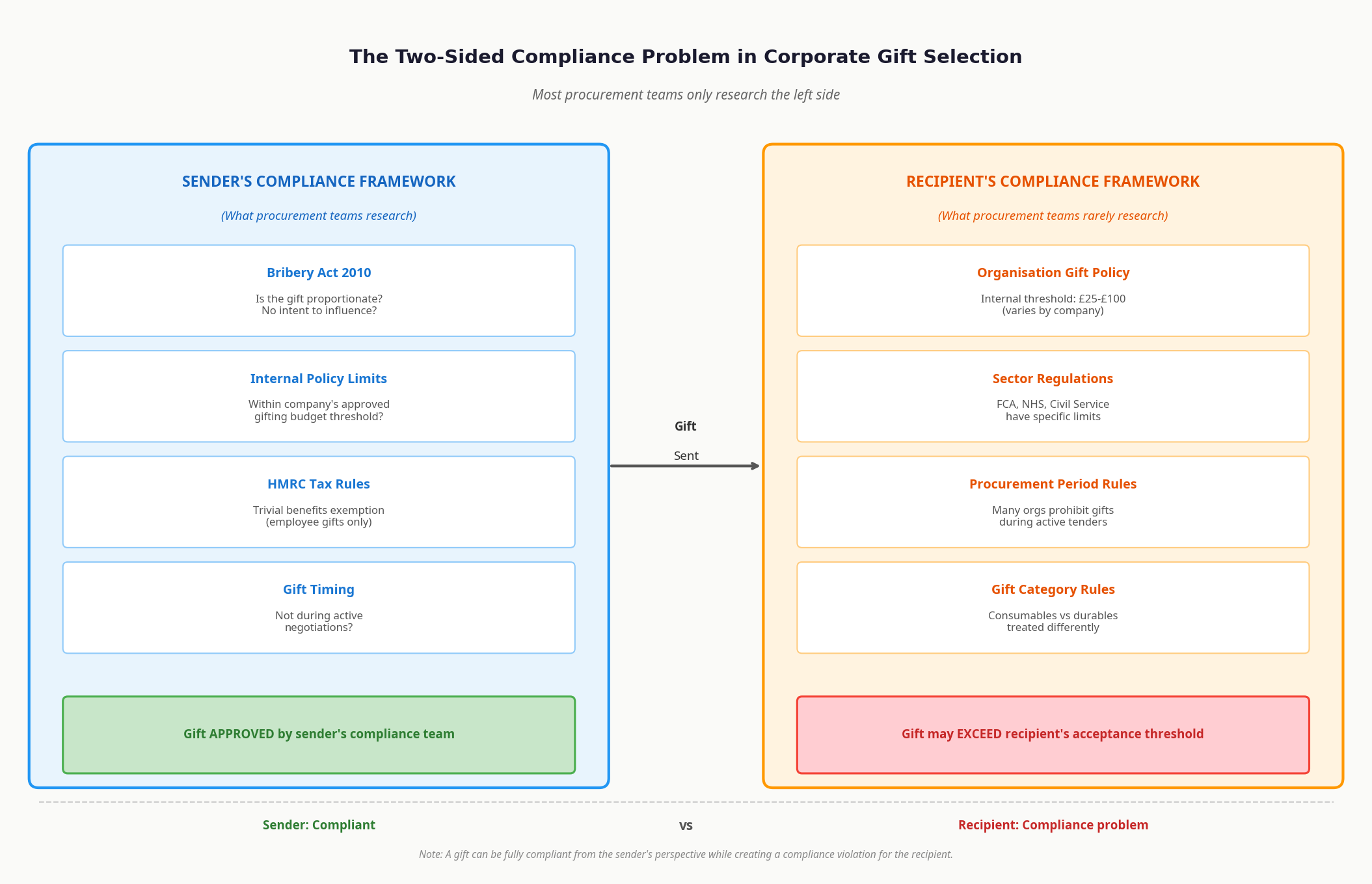

Why Your Approved Corporate Gift Box May Still Be Refused: The Recipient-Side Compliance Gap
5 March 2026
The assumption that runs through most corporate gifting programmes is that compliance is a sender-side problem. The procurement team reviews the Bribery Act 2010, confirms that the gift is proportionate and not intended to influence a specific decision, checks that it falls within the company's internal gifting policy, and proceeds. The gift is approved, ordered, and dispatched. From the sender's perspective, the compliance process is complete.
What this process systematically ignores is that the recipient operates under an entirely separate compliance framework—one that the sender has no visibility into and rarely considers. The recipient's organisation may have a gift acceptance policy that sets a threshold of £30 per item. It may prohibit the acceptance of any gifts during active contract negotiations or procurement periods. It may require that all gifts above a nominal value be declared to a compliance officer, regardless of the sender's intent. It may operate in a regulated sector—financial services, healthcare, government contracting—where gift acceptance rules are set not by internal policy but by external regulatory requirements.
[IMAGE:/images/blog/gift-selection-recipient-compliance-gap.png|Diagram showing the two-sided compliance problem: sender's framework on the left versus recipient's framework on the right, illustrating how a gift approved by the sender may still create a compliance issue for the recipient]
When a curated corporate gift box valued at £75 arrives at a financial services firm, the recipient faces a decision that the sender never anticipated. The gift is not a bribery attempt. It is not disproportionate by any reasonable standard. But the recipient's organisation has a £50 annual limit on gifts from any single supplier, and this gift alone exceeds it. The recipient now has three options, none of which are comfortable. They can decline and return the gift, which creates an awkward interaction and signals to the sender that the relationship is more formal than the sender assumed. They can accept and declare it, which triggers a compliance process, involves their compliance officer, and creates an administrative record of a gift that exceeded policy limits. Or they can accept without declaring, which places them in technical violation of their own organisation's policies. The sender's well-intentioned gift has created a compliance problem for the recipient that the sender will likely never know about.
This dynamic is particularly acute in certain sectors. Financial services firms regulated by the FCA operate under conduct rules that treat gifts and hospitality as potential conflicts of interest; many have internal policies that set gift acceptance thresholds at £50 or below, and some prohibit gifts entirely from suppliers during active contract periods. NHS procurement teams are subject to the NHS Standards of Business Conduct, which require declaration of all gifts above a nominal value and prohibit acceptance of gifts that could be seen as influencing procurement decisions. Government contractors and public sector clients operate under civil service gift acceptance guidelines that require declaration of all gifts regardless of value. Large corporate clients in sectors with active anti-corruption programmes—mining, pharmaceuticals, defence—often have zero-tolerance policies during specific periods of the commercial relationship.
The gift type decision is where this compliance asymmetry becomes a practical problem. A branded pen or a small promotional item typically falls below any reasonable gift acceptance threshold and can be accepted without triggering a compliance process. A luxury corporate hamper at £120 will exceed the acceptance threshold of a significant proportion of UK corporate recipients. A curated gift box at £75 sits in a grey zone where it will be acceptable to some recipients and problematic for others—and the sender has no reliable way to know which category a given recipient falls into without explicitly researching the recipient's policies.
[IMAGE:/images/blog/gift-selection-recipient-sector-risk.png|Matrix showing gift type acceptance risk by recipient sector: branded promotional items, food hampers, curated gift boxes, luxury hampers, and gifts during active procurement periods, rated across private SME, large corporate, financial services, and NHS/public sector recipients]
In practice, this is often where gift type decisions start to be misjudged at the procurement level. The procurement team selects gift categories based on what they can afford to send and what they believe communicates the right message. The question of what the recipient can afford to receive—in compliance terms—is rarely part of the selection framework. This is not because procurement teams are careless; it is because the recipient's acceptance policies are not publicly available in most cases, are not discussed in the commercial relationship, and are not visible to the sender at the point of gift selection.
The timing dimension adds a further layer of complexity. Many organisations that have relatively permissive gift acceptance policies in general become significantly more restrictive during specific periods of the commercial relationship. Active procurement processes, contract renewal negotiations, and periods of commercial dispute are all times when gift acceptance policies typically tighten. A gift that would be accepted without comment at any other point in the year may be declined or flagged if it arrives during a contract renewal period—not because the gift itself is problematic, but because the timing creates an appearance of impropriety that the recipient's compliance team cannot ignore.
This creates a specific problem for the most common corporate gifting calendar: the December Christmas period. December is, for many organisations, simultaneously the most popular time to send corporate gifts and the most sensitive time from a compliance perspective. Year-end contract renewals, budget discussions for the following year, and ongoing procurement processes all concentrate in Q4. A gift that arrives in December during an active contract negotiation is evaluated by the recipient's compliance team against a much more cautious standard than the same gift would be in February. The sender's December gifting programme, designed to strengthen relationships at year-end, may be creating compliance anxiety for recipients at precisely the moment when the commercial relationship is most active.
The practical implication for gift type selection is that the category of gift—not just the value—affects how it is processed by the recipient's compliance function. A consumable gift (food, drink) is typically treated differently from a durable gift (branded merchandise, luxury items) in many gift acceptance policies, because consumables are shared and do not create a lasting personal benefit. A gift sent to a team rather than an individual is often treated differently from a personal gift, because it distributes the benefit across multiple people and reduces the appearance of personal influence. A gift that is clearly branded with the sender's company identity is often treated more permissively than an unbranded luxury item, because the branding makes the commercial nature of the relationship explicit.
Understanding how different gift types interact with recipient-side compliance frameworks requires a different kind of research than most procurement teams conduct. Rather than asking "what gift communicates the right message at this budget level," the question becomes "what gift category can be accepted by the broadest range of recipients in our client portfolio without triggering compliance processes." For clients in regulated sectors, this often means selecting gift types that are inherently lower-risk from a compliance perspective—consumables, team gifts, branded items—rather than luxury personal items that may exceed acceptance thresholds. The question of which gift type best serves different business needs, as explored in [guidance on matching gift categories to commercial context](/resources/corporate-gift-selection-guide), cannot be answered without understanding both what the sender can give and what the recipient can accept.
The sender-side compliance framework that most procurement teams operate within is necessary but not sufficient. A gift that is proportionate, transparent, and consistent with the Bribery Act 2010 can still create a compliance problem for the recipient if it exceeds their organisation's acceptance threshold, arrives during a sensitive commercial period, or falls into a gift category that their sector treats with particular caution. The gift type decision is therefore a two-sided compliance problem, and procurement teams that only research one side of it will consistently create situations where their approved gifts are declined, declared, or accepted under duress—none of which achieves the relationship objective the gift was intended to serve.
You May Also Like
Rigid Box vs. Corrugated Mailer: Which Material Suits Your Premium Corporate Gifts?
A deep dive into the structural integrity, cost implications, and unboxing experience of rigid boxes versus corrugated mailers for high-end corporate gifting.
Foil Stamping vs. UV Spot: Elevating Your Brand Logo on Custom Gift Boxes
A technical comparison of hot foil stamping and UV spot varnish, analyzing visual impact, durability, and production costs for branded corporate packaging.