Back to BlogCorporate Gift Selection 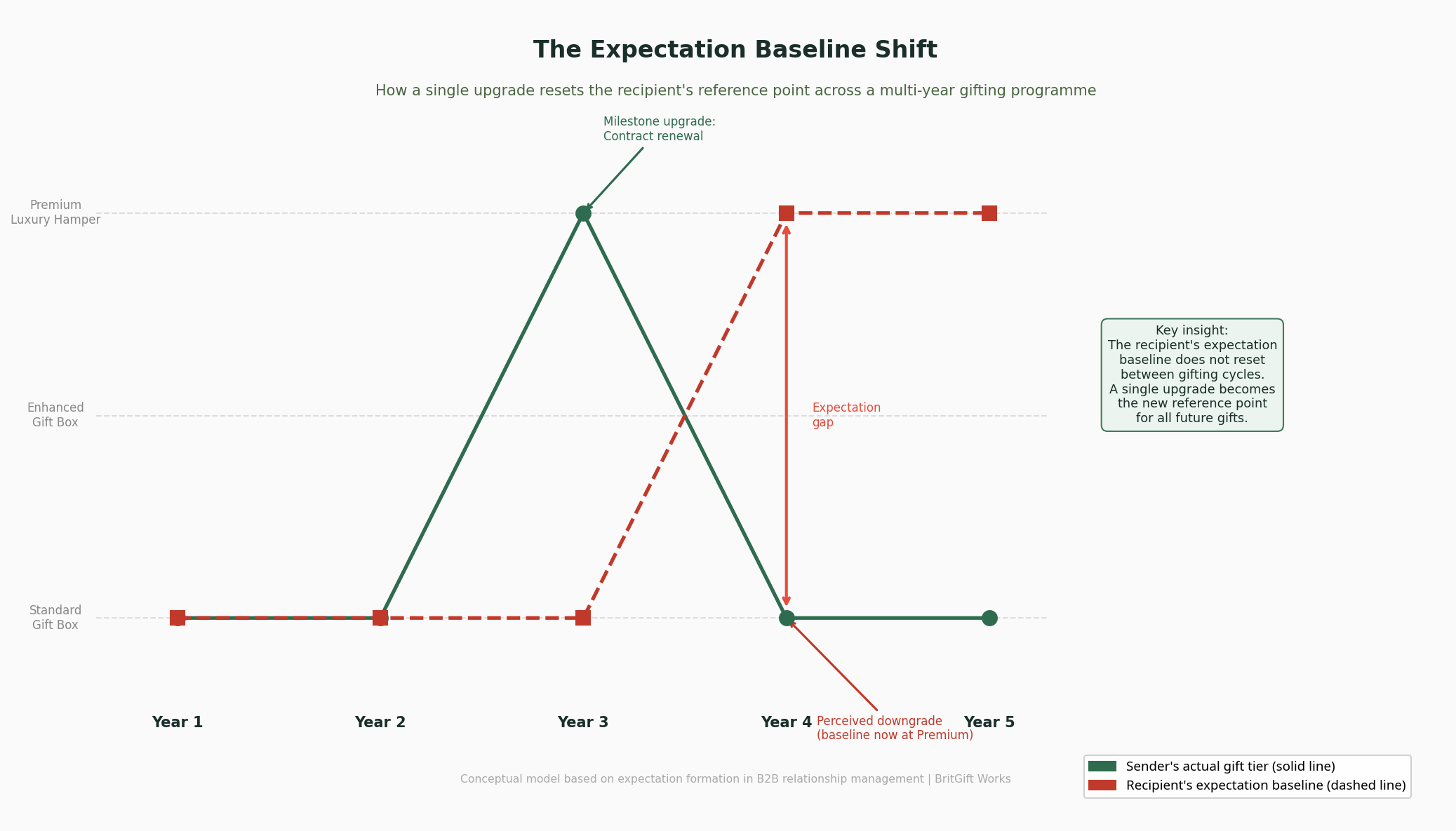
Why Selecting Corporate Gift Types as if Each Gifting Cycle Were Independent Creates an Expectation Trajectory You Cannot See But Your Clients Can
2026-04-02
There is a category of gifting error that only becomes visible in retrospect, usually when a long-standing client relationship begins to cool without any obvious trigger. The procurement team reviews the account. The service record is clean. The pricing is competitive. The account manager has maintained regular contact. And yet something has shifted. In many of these cases, when the history is examined carefully, the inflection point traces back not to a service failure, but to a gift.
The specific failure is not that a gift was poorly chosen in isolation. It is that the gift was chosen as if it were the first one ever sent. In practice, this is often where corporate gift type decisions start to be misjudged — not because the item itself was wrong, but because the selection logic ignored the expectation trajectory that years of prior gifting had already established.
Most procurement frameworks treat each gifting cycle as a discrete event. Budget is allocated. A category is selected. Items are approved and dispatched. The decision criteria centre on the current relationship status, the occasion, and the available budget. What is almost never considered is the invisible baseline that the recipient has already formed based on everything they have received before.
Recipients do not evaluate gifts in isolation. They evaluate them against memory. A client who received a premium luxury hamper in year three of a relationship — because the account had grown significantly and the account manager wanted to mark the milestone — does not reset their expectations in year four. They carry forward a reference point. If year four returns to the standard gift box tier that was sent in years one and two, the absolute quality of that gift may be entirely respectable. But it will not be experienced as respectable. It will be experienced as a step back. The relationship signal it transmits is not "we value you at this level." It is "we valued you more last year."
This dynamic is structurally different from the more commonly discussed problem of sending the wrong gift type for a given relationship stage. That problem concerns the appropriateness of a single selection at a specific moment. The expectation trajectory problem concerns the cumulative pattern that multiple selections have created over time, and how any new selection is interpreted within that pattern.
The practical consequence is that gift type decisions made in isolation — each year optimised for that year's circumstances — can inadvertently construct a narrative that the sender never intended. A series of reasonable individual decisions can produce an unreasonable cumulative signal. An upgrade sent to mark a contract renewal creates an expectation that the upgraded tier is now the baseline. A downgrade the following year, even if driven by entirely legitimate budget constraints, reads as a withdrawal of recognition rather than a neutral budgetary adjustment.
What makes this particularly difficult to manage is that the expectation trajectory is invisible to the sender but entirely visible to the recipient. The sender's procurement team has no systematic record of what was sent in prior years, at what tier, and what the relational context was at the time. The recipient remembers. Not necessarily consciously or with resentment, but as a felt sense of whether the relationship is being maintained, deepened, or quietly deprioritised.
Bespoke corporate gift boxes — the kind that can be curated and reconfigured year on year — offer a structural advantage here that standardised catalogue gifts do not. When the physical format of the gift remains consistent but the contents, quality tier, and presentation can be adjusted, it becomes possible to manage the expectation trajectory deliberately. The recipient experiences continuity in the gesture while the sender retains the flexibility to modulate investment in line with the relationship's actual trajectory. A hamper that arrives every year in a recognisable format but with contents that subtly reflect the current relationship depth is a very different signal from a hamper that is identical every year regardless of how the relationship has evolved.
The error that most procurement teams make is conflating gift type selection with gift value selection. They assume that as long as the monetary value remains consistent, the relational signal remains consistent. But recipients do not experience monetary value directly. They experience category, format, and perceived effort. A gift that arrives in the same box as last year but with noticeably less premium contents will be read as a downgrade even if the price difference is marginal. A gift that arrives in a new format with comparable contents may be read as a refresh rather than a reduction.
There is also a secondary problem that the expectation trajectory creates for new account managers who inherit established relationships. They receive a client file with revenue history and contact notes, but rarely with any record of what has been sent as gifts over the preceding years. They make their first gifting decision based on the current relationship status and their own judgement of what is appropriate. If they send something that falls below the baseline the previous account manager had established, the client experiences a discontinuity that has nothing to do with the new manager's intentions and everything to do with an undocumented expectation.
The solution is not to escalate gift quality indefinitely to avoid ever triggering a perceived downgrade. That path leads to unsustainable programme costs and a different kind of problem. The solution is to treat gifting history as a relationship asset that requires active management — to document what was sent, at what tier, and in what relational context, and to make subsequent decisions with that history explicitly in view. When a downgrade is genuinely necessary, it should be accompanied by a deliberate change in format or occasion framing that signals intentionality rather than neglect. When an upgrade is made to mark a milestone, it should be understood that a new baseline has been set, and the programme should plan accordingly.
The broader question of which gift types best serve different business needs cannot be answered without knowing the history of what has already been sent. A gift type that would be perfectly appropriate for a new client relationship may be entirely inappropriate for a five-year relationship where a different tier has already been established as normal. The decision framework has to account for trajectory, not just current status.
BritGift Works' bespoke corporate gift box service is designed with this constraint in mind. The ability to reconfigure contents, presentation tier, and curation focus year on year — while maintaining a consistent format that the recipient recognises — is not a cosmetic feature. It is the mechanism by which a gifting programme can manage expectation trajectory rather than be managed by it.
You May Also Like
Rigid Box vs. Corrugated Mailer: Which Material Suits Your Premium Corporate Gifts?
A deep dive into the structural integrity, cost implications, and unboxing experience of rigid boxes versus corrugated mailers for high-end corporate gifting.
Foil Stamping vs. UV Spot: Elevating Your Brand Logo on Custom Gift Boxes
A technical comparison of hot foil stamping and UV spot varnish, analyzing visual impact, durability, and production costs for branded corporate packaging.