Back to BlogCORPORATE GIFT SELECTION 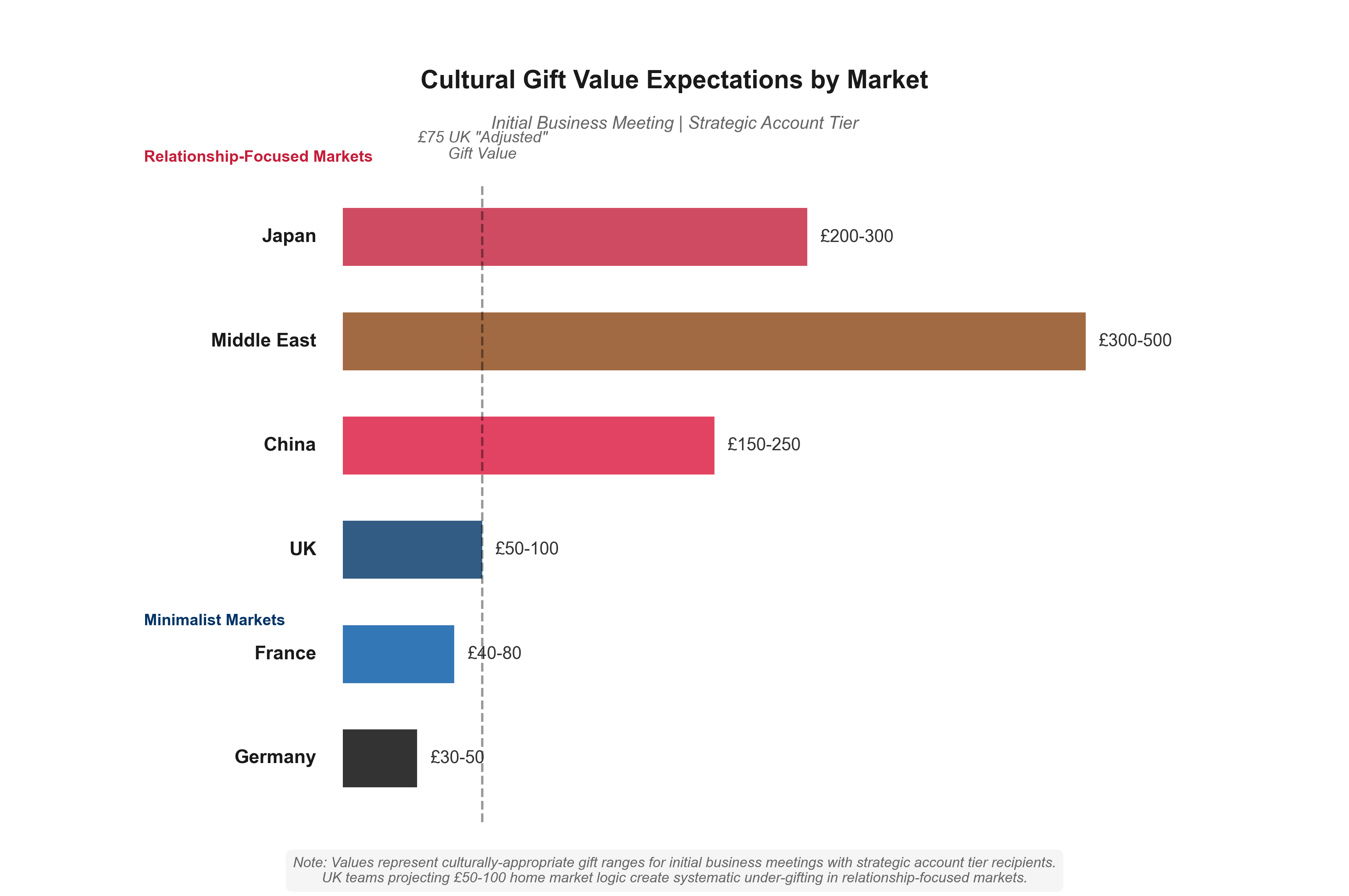

Why Your £75 Corporate Gift Box Signals 'Low Priority' in Japan and 'Inappropriate Influence' in Germany
26 February 2026
When procurement teams in London select corporate gift boxes for international clients, the systematic pattern of failure isn't random. It follows a predictable trajectory that stems from a single cognitive blind spot: projecting home market gift-giving logic onto recipients operating under fundamentally different cultural frameworks. The £50 HMRC trivial benefits threshold, designed as a UK tax compliance ceiling for employee gifts, becomes weaponized as a universal gift value limit—applied indiscriminately to Japanese clients expecting £200-300 relationship initiation gifts, German partners who view any gift during negotiations as inappropriate, and Middle Eastern strategic accounts where £300-500 is the culturally-appropriate signal of partnership intent.
This isn't a knowledge gap. Most procurement teams are aware that "cultural differences exist." The misjudgment occurs at a deeper level: teams treat their home market's gift-giving framework as the default baseline, then apply minor adjustments for "cultural sensitivity." A UK team might increase a £50 gift to £75 for a "high-value Japanese client," believing they've accounted for cultural difference. In practice, they've created a systematic under-gifting failure that signals to the Japanese recipient: "This relationship isn't a priority." The inverse occurs with German clients, where the same £75 gift—selected because it's "modest by UK standards"—creates discomfort during partnership discussions, as German business culture reserves gift-giving for established relationships, not active negotiations.
[IMAGE:/images/blog/cultural-gift-value-expectations.png|Cultural gift value expectations comparison across different markets for initial business meetings]
The home market projection operates through three reinforcing mechanisms. First, procurement teams anchor on their domestic compliance thresholds as if they represent universal ethical boundaries. The UK Bribery Act 2010 doesn't specify a monetary limit for business gifts—it evaluates intent, proportionality, and transparency. Yet procurement teams translate this into an implicit £50-100 ceiling, treating anything above as "potentially inappropriate." This ceiling is then applied to all international recipients, regardless of their market's cultural norms. Second, teams select gift categories based on home market symbolic meaning. A "premium food hamper" signals thoughtfulness and quality in the UK. The same category in China may signal "I don't know you well enough to personalize this gift," while in Japan it's acceptable only if sourced from a brand with cultural significance. Third, teams treat gift value as a function of recipient tier (VIP client = higher value) rather than relationship stage + cultural context. In Latin America, a modest gift before partnership discussions builds personal connection; the same gift after contract signing may be perceived as attempting to influence future decisions.
The practical consequence isn't just relationship damage—it's budget waste through cultural mismatch. A £15,000 budget allocated for 100 international clients, distributed as uniform £150 corporate gift boxes, achieves approximately 20% effective utilization. Fifty recipients in relationship-focused markets (Japan, Middle East, China) receive gifts that signal insufficient commitment. Thirty recipients in minimalist markets (Germany, Sweden, France) receive gifts that create compliance anxiety or cultural discomfort. Twenty recipients receive culturally misaligned gift categories that fail to communicate the intended message. Only the remaining recipients—those whose market norms happen to align with UK gift-giving logic—experience the gift as intended.
[IMAGE:/images/blog/home-market-projection-failure.png|Home market projection failure pattern showing systematic misjudgment across international recipients]
The misjudgment persists because centralized procurement optimizes for efficiency (uniform gift selection, bulk ordering, simplified logistics) rather than effectiveness (culturally-appropriate selection that achieves business objectives). When a procurement team in London manages gifts for Japanese clients at relationship initiation stage, German clients in established partnerships, and Middle Eastern strategic accounts, each segment requires different gift categories, values, and timing logic. Attempting to create a "culturally-neutral" corporate gift box—one that won't offend anyone—produces a gift that fails to build relationships with anyone. Cultural neutrality in gift-giving doesn't exist; every gift communicates a message, and that message is interpreted through the recipient's cultural framework, not the sender's.
The systematic failure becomes visible when examining gift selection across recipient markets. A UK procurement team selects a £100 premium British food hamper for all international clients, believing it represents "quality and thoughtfulness." The Japanese client, receiving this at an initial business meeting, interprets it as: "This company hasn't invested time to understand our market or our preferences—they've sent a generic UK product." The German client, receiving the same gift during partnership negotiations, experiences discomfort: "Why are they giving me a gift now? Are they trying to influence our decision?" The Middle Eastern strategic account, expecting a £300-500 gift as a signal of their importance, interprets the £100 hamper as: "We're not a priority client for this supplier." Each recipient's interpretation is correct within their cultural framework. The procurement team's intent—"demonstrate appreciation and build relationships"—is lost in translation.
This pattern explains why procurement teams consistently report that "corporate gifting doesn't deliver ROI" in international markets. The issue isn't the practice of corporate gifting—it's the systematic application of home market gift-giving logic to recipients operating under different cultural frameworks. When [selecting gifts for diverse business needs](/resources/corporate-gift-selection-guide), the first decision isn't "what gift category" or "what budget tier"—it's understanding that your home market's gift-giving framework is an implicit assumption, not a universal baseline. Until procurement teams recognize that the £50 HMRC threshold is a UK tax compliance rule (not a global ethical ceiling), that gift categories carry culture-specific symbolic meaning, and that gift timing follows relationship stage logic that varies by market, the systematic pattern of cultural misjudgment will continue—regardless of how much budget is allocated or how "premium" the gift boxes appear.
You May Also Like
Rigid Box vs. Corrugated Mailer: Which Material Suits Your Premium Corporate Gifts?
A deep dive into the structural integrity, cost implications, and unboxing experience of rigid boxes versus corrugated mailers for high-end corporate gifting.
Foil Stamping vs. UV Spot: Elevating Your Brand Logo on Custom Gift Boxes
A technical comparison of hot foil stamping and UV spot varnish, analyzing visual impact, durability, and production costs for branded corporate packaging.