Back to BlogCorporate Gift Selection 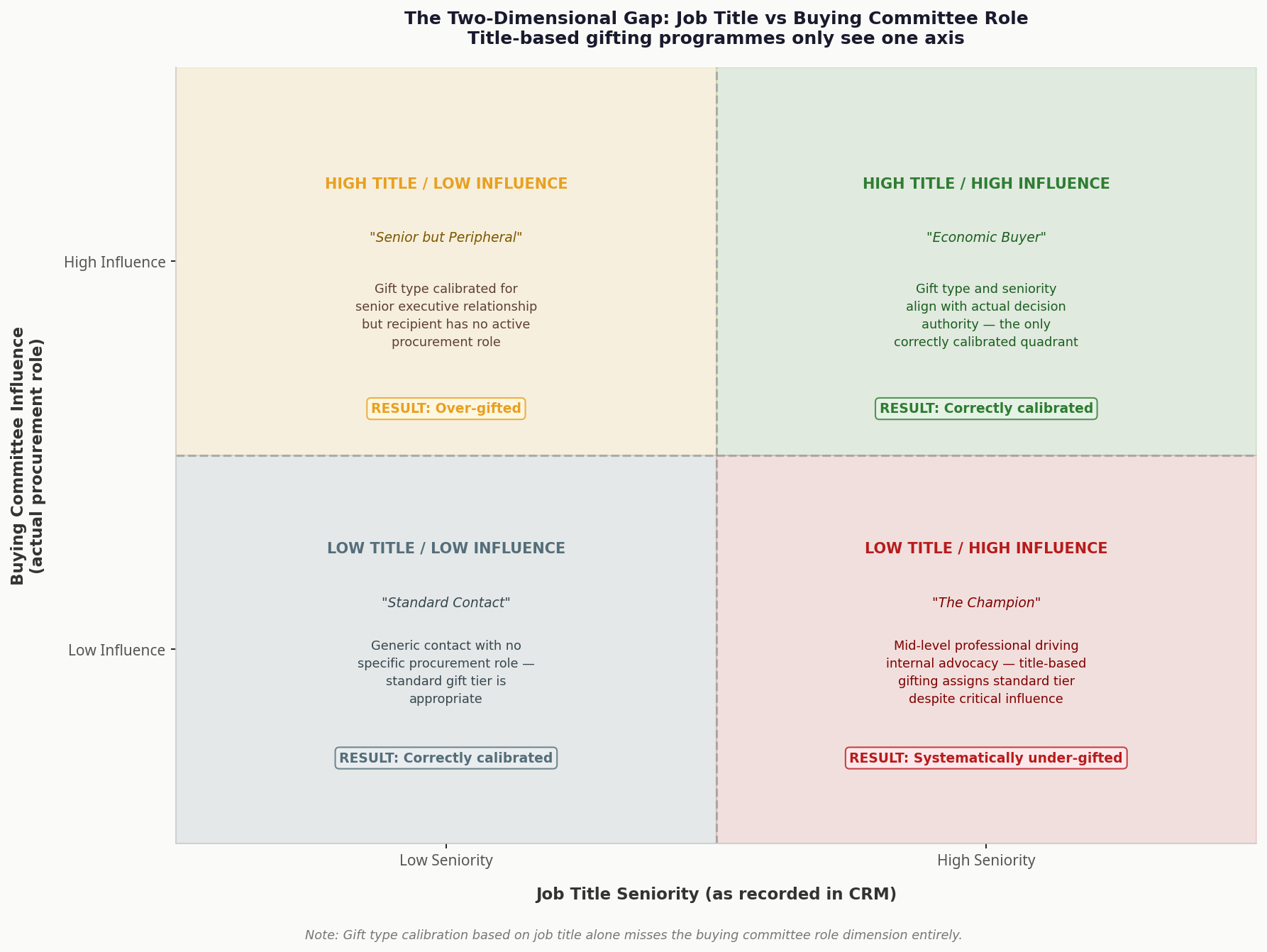

Why Selecting Corporate Gift Types by Job Title Rather Than Buying Role Creates Systematic Misfires
9 March 2026
There is a particular category of gifting error that only becomes visible when a supplier's gift triggers a conflict of interest investigation at the recipient's organisation. The gift itself is entirely appropriate by any standard measure — the value is within policy limits, the timing is not adjacent to a contract signing, and the supplier has a long-standing relationship with the recipient. The problem is that the recipient is currently sitting on the evaluation committee for a tender that includes the gift sender as a bidder. The gift was selected based on the recipient's job title. Nobody checked their current procurement role.
This scenario is more common than most gifting programme managers would expect, and it is caused by a structural gap in how gift type decisions are made. The overwhelming majority of corporate gifting programmes are organised around CRM contact seniority — the job title field that signals whether someone is a C-suite executive, a director, a manager, or a coordinator. Gift type and budget tier are then assigned accordingly: executives receive premium hampers, directors receive mid-tier gift sets, managers receive standard branded merchandise. The logic appears sound because it mirrors the internal hierarchy. What it does not mirror is the buying committee structure, which is an entirely different organisational dimension.
In B2B procurement, the person who holds the formal authority to sign a contract is rarely the same person who determines the outcome of a technical evaluation, and neither of them is the same as the internal champion who has been advocating for a particular supplier for months without any formal mandate to do so. These functional roles — economic buyer, technical evaluator, end user, champion, gatekeeper — do not map predictably onto job titles. A Director of IT may be the technical evaluator for a software procurement but have no authority over the budget. A Procurement Manager may be the economic buyer for a £500,000 contract but receive a mid-tier gift because their title does not signal seniority to the gifting programme's logic. A senior account manager with no formal title in the procurement process may be the champion whose internal advocacy is the single most important factor in the decision — and they receive the same generic gift as every other contact at their seniority level.
[IMAGE:/images/blog/gift-selection-buying-role-title-matrix.png|Matrix showing how job title seniority and buying committee influence create four distinct gifting scenarios that require different gift type strategies: senior but peripheral contacts are over-gifted, champions are systematically under-gifted, economic buyers are correctly calibrated, and standard contacts are correctly calibrated]
The practical consequence is that gifting programmes systematically under-invest in the relationships that matter most and over-invest in relationships that are formally senior but functionally peripheral to the specific procurement in question. This is not a failure of intent — the procurement team selecting the gifts is trying to invest appropriately. It is a failure of data. The CRM contact record contains a job title. It does not contain a field for "current role in active procurement evaluation." That field either does not exist or is not maintained with sufficient accuracy to inform gifting decisions.
In practice, this is often where gift type decisions start to be misjudged at the programme level. The gift type assigned to a technical evaluator — a premium hamper, for example — communicates a relationship investment that is calibrated for an economic buyer. The technical evaluator receives a signal that the supplier is treating them as a decision-maker, which may be flattering but is also potentially problematic. In organisations with robust conflict of interest policies, receiving a gift that is calibrated above one's actual procurement authority can trigger a disclosure obligation. The evaluator must now declare the gift to their compliance function, which creates a documented record of a gift received from a bidder during an active evaluation period. The gift that was intended to strengthen a relationship has instead created an administrative burden and a compliance record that the evaluator would have preferred not to have.
The procurement blackout period problem compounds this. Many large organisations — particularly those in financial services, public sector, and regulated industries — operate formal blackout periods during which suppliers are prohibited from providing any gifts, hospitality, or entertainment to anyone involved in an active procurement evaluation. These blackout periods are not always communicated to suppliers, and they are not always visible in the CRM. A supplier's gifting programme may dispatch its quarterly relationship gifts on a fixed schedule, with no mechanism to check whether any recipient is currently inside a blackout period. The gift type is irrelevant in this context — a modest branded gift set triggers the same compliance obligation as a luxury hamper if it arrives during a blackout period. The error is not in the gift type selection; it is in the absence of a procurement status check before dispatch.
[IMAGE:/images/blog/gift-selection-procurement-blackout-timeline.png|Timeline showing procurement evaluation blackout periods during which any corporate gift type creates compliance disclosure obligations regardless of value — gift type selection only becomes relevant outside active evaluation periods]
The champion relationship presents a different kind of misalignment. Champions are the internal advocates who drive supplier preference without formal authority. They are often mid-level professionals — a senior analyst, a project lead, a technical architect — whose job titles do not signal their actual influence. A gifting programme that assigns gift types by seniority will consistently under-invest in champions, sending them the same mid-tier gift that goes to every contact at their level. The opportunity cost is significant. The champion is the person most likely to be presenting the supplier's case in internal discussions, most likely to be countering objections from sceptical stakeholders, and most likely to be the reason the supplier is on the shortlist at all. Investing in this relationship at the same level as a generic contact at the same seniority tier is a structural misallocation.
The question of which gift types best serve different business needs, as explored in the [broader framework for matching gift categories to commercial objectives](/resources/corporate-gift-selection-guide), is typically framed around relationship stage, recipient preferences, and budget constraints. The buying committee role dimension is almost never part of that framework, because it requires a level of account intelligence that most gifting programmes do not systematically collect or maintain. What procurement teams can do is apply a minimum viable check before any gift is dispatched to an active account: is this recipient currently involved in any procurement evaluation that includes our organisation? If the answer is yes or unknown, the gift should be held until the evaluation is complete. This single check, applied consistently, eliminates the most serious compliance risks associated with gift type selection — regardless of what type of gift is being sent.
The deeper structural fix requires treating buying committee role as a first-class data field in the account management system, not as an informal piece of knowledge held by the account manager. When a contact's role in an active procurement is recorded and visible to the gifting programme, gift type decisions can be made with the full context of what that relationship actually represents. A premium eco-friendly gift box sent to an economic buyer who has just signed a contract communicates something entirely different from the same box sent to a technical evaluator who is currently assessing competing bids. The gift type is identical. The commercial context is not. And it is the commercial context — not the job title, not the gift value, not the packaging — that determines whether the gift strengthens or complicates the relationship it was intended to serve.
You May Also Like
Rigid Box vs. Corrugated Mailer: Which Material Suits Your Premium Corporate Gifts?
A deep dive into the structural integrity, cost implications, and unboxing experience of rigid boxes versus corrugated mailers for high-end corporate gifting.
Foil Stamping vs. UV Spot: Elevating Your Brand Logo on Custom Gift Boxes
A technical comparison of hot foil stamping and UV spot varnish, analyzing visual impact, durability, and production costs for branded corporate packaging.