Back to BlogCorporate Gift Selection 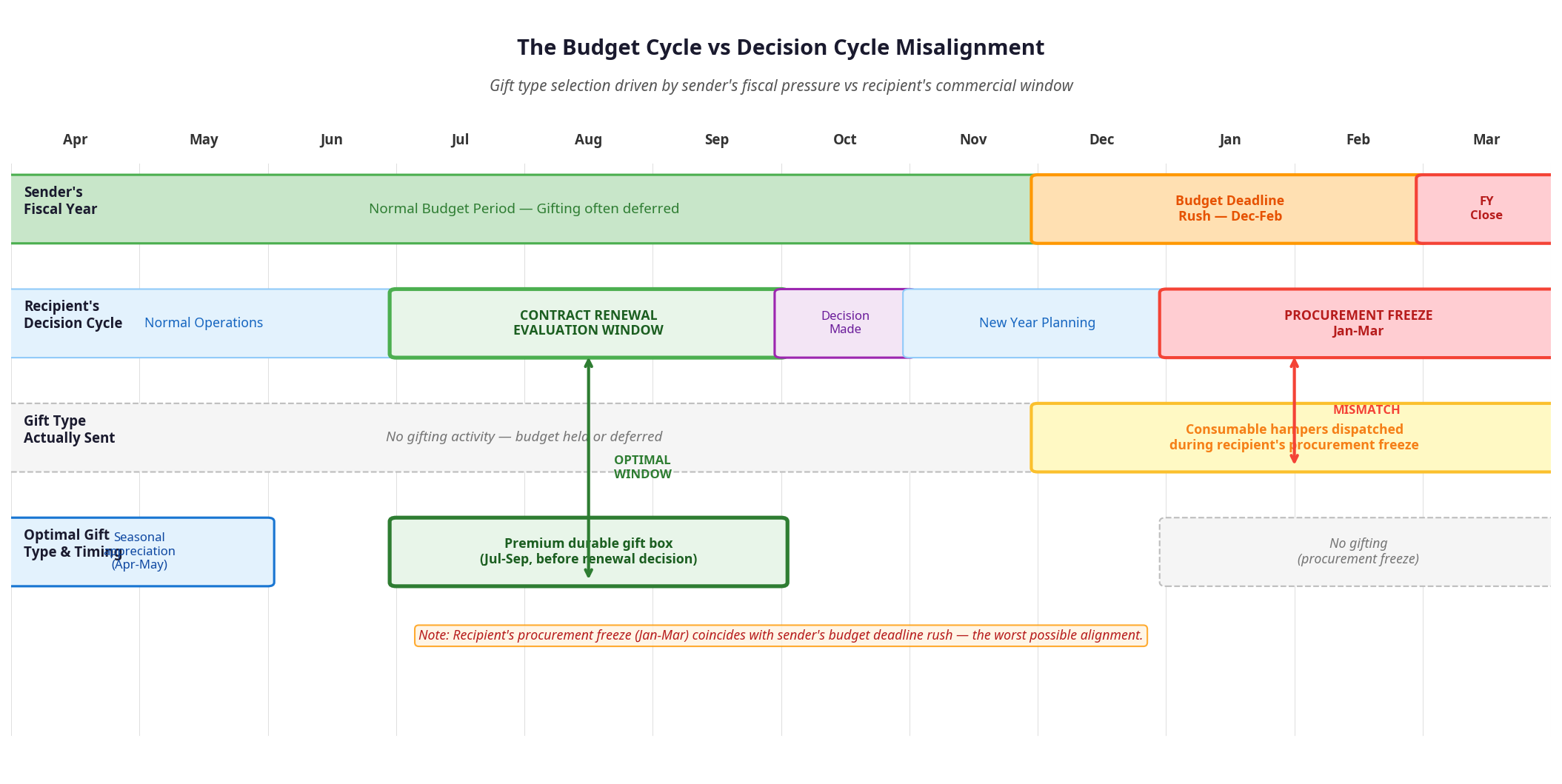
Why Aligning Corporate Gift Type Selection to Your Own Budget Cycle Rather Than the Recipient's Decision Cycle Inverts the Commercial Logic
2026-03-20
There is a structural misalignment in how most UK businesses approach corporate gift type selection that rarely gets named directly, even though its consequences are visible in almost every gifting programme that runs on an annual cycle. The misalignment is this: the gift type is chosen to match the timing of available budget, rather than the timing of commercial relevance to the recipient.
In practice, this is where gift type decisions start to be systematically misjudged. A business with a March financial year-end finds itself in late February with an unspent gifting allocation. The pressure is real — budget that isn't committed before the year closes is typically surrendered, and finance teams treat unspent discretionary spend as evidence that the allocation was too generous. So the procurement or marketing team makes a decision under time pressure, and that pressure shapes the gift type selected. Consumable gift boxes — hampers, food and drink sets, spa vouchers — are chosen not because they are strategically appropriate for the recipient relationship, but because they can be sourced and dispatched within two to three weeks. The decision is driven entirely by the sender's operational constraint.
What this misses is that the recipient's commercial calendar operates on a completely different rhythm. A client whose contract comes up for renewal in September is not in a decision-making window in February. They are in the middle of their operational year, probably not thinking about supplier relationships in any evaluative way. A hamper arriving in late February registers as a pleasant but unremarkable gesture. The same investment directed toward a premium durable gift — a quality branded notebook set, a well-curated eco-friendly desk accessory box — sent in July, when the recipient's procurement team is beginning to evaluate supplier performance ahead of September renewal discussions, would carry significantly more commercial weight. The gift type that is appropriate at one point in the recipient's decision cycle is not the same gift type that is appropriate at another.
The fiscal year mismatch creates a second, less obvious problem. Many large UK organisations — particularly those in financial services, professional services, and the public sector — operate procurement freezes in the final quarter of their own financial year. A client with a March year-end is typically in a procurement freeze from January through March, during which new supplier commitments are discouraged and any incoming gifts that require acknowledgment or compliance disclosure create administrative friction rather than goodwill. A gift arriving during a procurement freeze does not land in the same psychological space as a gift arriving during a period of active relationship investment. The gift type that would be welcome in October becomes an administrative inconvenience in February — not because the gift is wrong, but because the timing has transformed its meaning.
The deeper issue is that gift type selection and gift timing are treated as separate decisions in most procurement processes, when they are actually a single decision. The type of gift that is appropriate for a relationship-maintenance moment — a consumable, seasonal, low-commitment gesture — is different from the type of gift that is appropriate for a relationship-investment moment — a durable, branded, premium object that will remain in the recipient's environment. When timing is driven by budget availability rather than commercial strategy, the gift type defaults to whatever is available quickly, which is almost always the consumable category. This is not a coincidence. Consumable gifts have shorter production lead times, lower minimum order quantities, and simpler logistics. They are the natural choice when the primary constraint is speed rather than strategic fit.
The consequence is a systematic pattern: businesses consistently under-invest in durable gift categories at the moments when durable gifts would generate the most commercial return, and over-invest in consumable categories at the moments when consumable gifts generate the least. The relationship-investment moments — contract renewal windows, new business development phases, post-project completion periods — go ungifted because the budget has already been spent in February on hampers that arrived during the recipient's procurement freeze.
This pattern is particularly visible in how businesses approach the question of which gift categories best serve different commercial objectives. The answer to that question is not fixed — it depends on where the recipient is in their own decision cycle, not where the sender is in their budget cycle. A premium gift box containing quality branded items that will remain on a desk for twelve months is the right type of gift when the recipient is about to make a supplier evaluation decision. A seasonal hamper is the right type of gift when the relationship is stable and the gesture is purely one of appreciation. Conflating these two categories — or defaulting to the consumable category because it is easier to procure under time pressure — means the commercial logic of the gifting investment is inverted.
The correction is structural rather than tactical. It requires mapping the gifting calendar to the recipient's decision cycle rather than the sender's budget cycle. For a client portfolio with staggered contract renewal dates, this means identifying the 90-day window before each renewal and reserving budget for that period, rather than allocating the entire gifting budget to a single Q4 or Q1 spend. It means accepting that some gifting budget will be held in reserve through the financial year, which requires a different kind of conversation with finance than most procurement teams are accustomed to having.
The gift types that are most appropriate for different business needs cannot be answered without reference to the recipient's commercial calendar. A premium eco-friendly gift box, with custom branding and high-quality contents, generates a fundamentally different commercial return when it arrives three months before a contract renewal than when it arrives because the budget needed to be spent before March. The gift type has not changed. The commercial context has. And the commercial context is what determines whether the investment was well-placed or simply well-intentioned.
You May Also Like
Rigid Box vs. Corrugated Mailer: Which Material Suits Your Premium Corporate Gifts?
A deep dive into the structural integrity, cost implications, and unboxing experience of rigid boxes versus corrugated mailers for high-end corporate gifting.
Foil Stamping vs. UV Spot: Elevating Your Brand Logo on Custom Gift Boxes
A technical comparison of hot foil stamping and UV spot varnish, analyzing visual impact, durability, and production costs for branded corporate packaging.